Top Strategies Every Fuel Distributor Should Know for Success
Smart Approaches to Safer, More Efficient Fuel Distribution and Sustainable Business Growth

Introduction
Fuel distribution plays an important role in keeping transportation, industry, agriculture, and communities supplied with essential energy. In a changing market, long-term business performance depends on more than simply moving products through a supply chain. Companies increasingly need strong governance, dependable logistics planning, customer-focused service, environmental responsibility, and a clear commitment to safety.
Recent industry reporting highlights the importance of resilient supply networks, transparent processes, technology, and coordinated planning. Pakistan State Oil, for example, has emphasized supply-chain integration, operational safety, product availability, disciplined commercial planning, and digital development in its FY2026 outlook.
Prioritize Safety and Regulatory Compliance
Safety should remain a fundamental business principle for any company operating in the energy sector. A strong safety culture includes appropriate training, documented responsibilities, risk management, emergency preparedness, and regular review of safety performance.
Industry sustainability programs increasingly combine process safety with contractor management, road-safety initiatives, equipment assurance, and emergency-response preparedness.
Compliance should also extend beyond minimum legal requirements. Maintaining accurate documentation, monitoring regulatory changes, and establishing clear accountability can help organizations reduce avoidable business and reputational risks.
Strengthen Supply Chain Resilience
Energy markets can be affected by changing demand, transportation disruptions, geopolitical events, weather, and infrastructure constraints. For distributors, resilience means having strong business-continuity planning and visibility across the wider supply network.
Supplier diversification, effective forecasting, and contingency planning can help businesses respond more effectively when unexpected disruptions occur. Research on energy supply chains in developing economies has identified supply uncertainty, infrastructure limitations, risk-management weaknesses, and demand uncertainty as significant challenges.
Use Technology for Better Business Visibility
Digital tools can help businesses understand performance and identify problems earlier. Modern supply-chain systems can support areas such as scheduling, inventory visibility, customer communication, documentation, financial reporting, and performance analysis.
The broader fuel-trading sector is also moving toward more structured digital compliance and risk-management processes, with greater emphasis on transparent documentation and verifiable business information.
Technology should therefore support decision-making rather than simply add complexity. Businesses can focus on systems that provide useful information to managers and improve coordination between departments.
Build Strong Customer Relationships
Reliable customer service remains an important part of sustainable business growth. Commercial customers generally value dependable communication, accurate documentation, transparent terms, and consistent service.
A customer-focused distributor can monitor service quality through appropriate business indicators, respond promptly to legitimate concerns, and maintain clear communication during periods of supply disruption.
Long-term relationships are often strengthened when businesses understand customer requirements and communicate realistic expectations rather than making promises they cannot consistently fulfill.
Improve Financial and Operational Discipline
Strong financial management is particularly important in industries affected by changing commodity prices and transportation costs.
Distributors can benefit from regularly reviewing operating expenses, receivables, supplier relationships, service performance, and broader business risks. Management reporting should make it easier to identify trends and investigate unusual changes.
The objective should be sustainable financial performance rather than short-term gains that create unnecessary operational or compliance risks.
Develop Responsible Supplier Relationships
A distributor’s reputation can be affected by the practices of its wider supply chain. Supplier selection and oversight should therefore consider compliance, integrity, safety, environmental performance, and responsible business conduct.
PETRONAS, for example, describes integrity, health and safety, environmental responsibility, and human rights as important elements of its sustainable supply-chain approach.
Clear supplier expectations and appropriate due diligence can help businesses build more transparent and resilient commercial relationships.
Make Sustainability Part of Long-Term Planning
Environmental responsibility is becoming increasingly relevant across energy supply chains. Sustainability can include measuring environmental performance, improving resource efficiency, reducing unnecessary emissions, and preparing for changing energy-market expectations.
Fuel supply chains are also seeing greater attention to traceability and sustainability information. Ipieca reported in 2026 on international work examining chain-of-custody models that can connect products with sustainability attributes and emissions information throughout supply chains.
For distributors, this makes accurate information and transparent reporting increasingly valuable.
Invest in People and Professional Development
People remain central to a successful distribution business. Employees need appropriate training, clear responsibilities, effective communication, and a workplace culture that encourages responsible decision-making.
Professional development can cover areas such as compliance awareness, customer service, data literacy, emergency preparedness, leadership, and business ethics.
A capable workforce is better positioned to identify potential problems early and contribute to continuous improvement.
Prepare for Changing Energy Markets
The energy sector is evolving. Businesses may face changing customer expectations, alternative-energy technologies, environmental requirements, digital transformation, and new approaches to transportation.
Forward-looking companies can monitor these developments and evaluate how they may affect their customers and business models. Some energy companies are already combining conventional distribution activities with initiatives involving energy efficiency, renewable energy, and electric-vehicle infrastructure.
The goal is not to predict every change, but to maintain enough flexibility to respond responsibly.
Conclusion
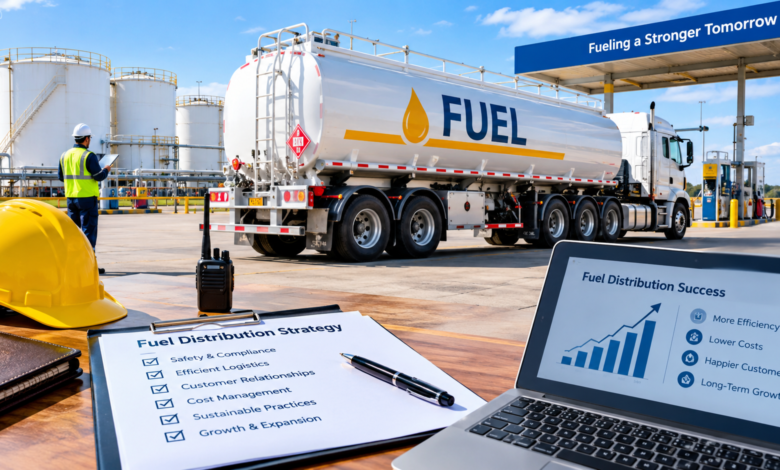
Success in fuel distribution increasingly depends on responsible business management rather than a single competitive advantage. Safety, compliance, resilient supply chains, technology, customer relationships, financial discipline, supplier oversight, sustainability, and workforce development all contribute to long-term organizational strength.
By building these principles into business planning, energy distributors can work toward dependable service while maintaining high standards of responsibility and preparing for a changing energy landscape.